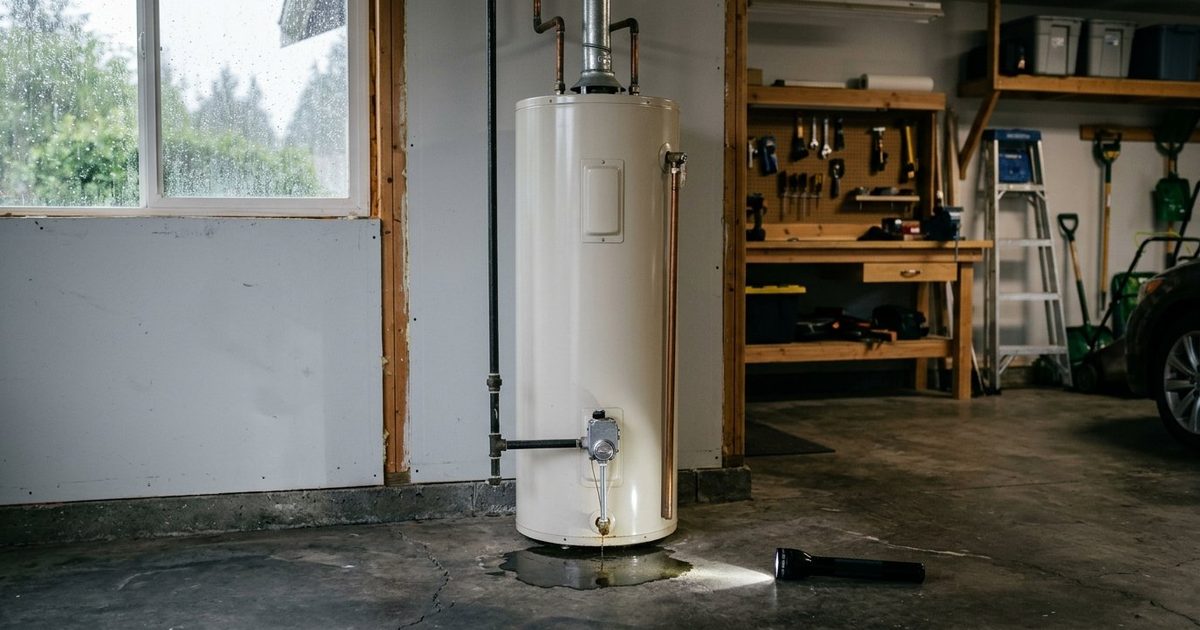
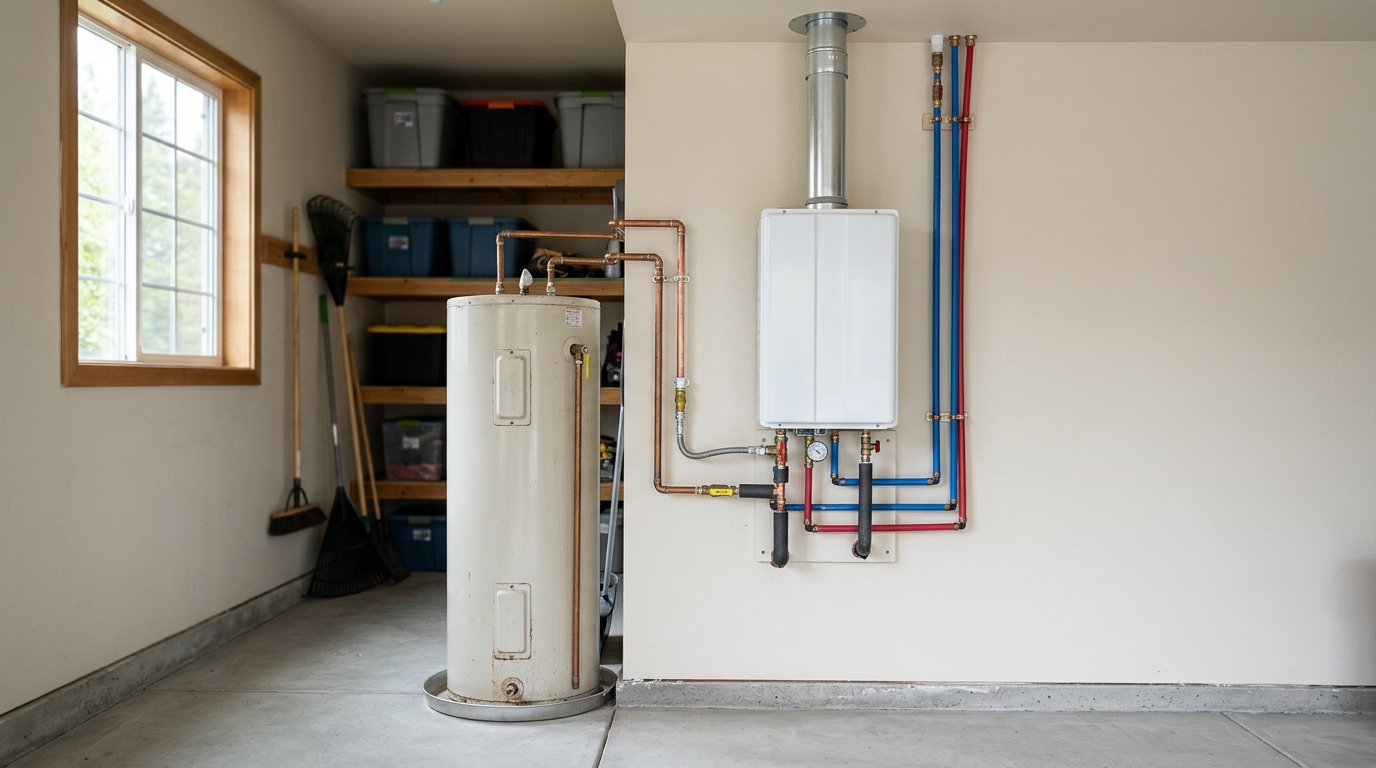
A tank water heater costs less to install and is the simpler swap when your old tank fails. A tankless water heater costs more up front, but it heats water only as you use it, so it doesn't run out mid-shower and doesn't waste energy keeping a tank hot all day.
Which one fits depends on how much hot water your household uses at once, what fuel and venting you already have, and how long you plan to stay in the house. This guide compares the two side by side, explains what drives the price of each in a Tacoma home, and lists the questions to ask before you pick.
How Each Type Works
A tank water heater keeps 40 to 50 gallons (sometimes more) hot and ready in an insulated tank. When you turn on a tap, hot water leaves the top and cold water refills the bottom. Once the tank is used up, you wait while it reheats.
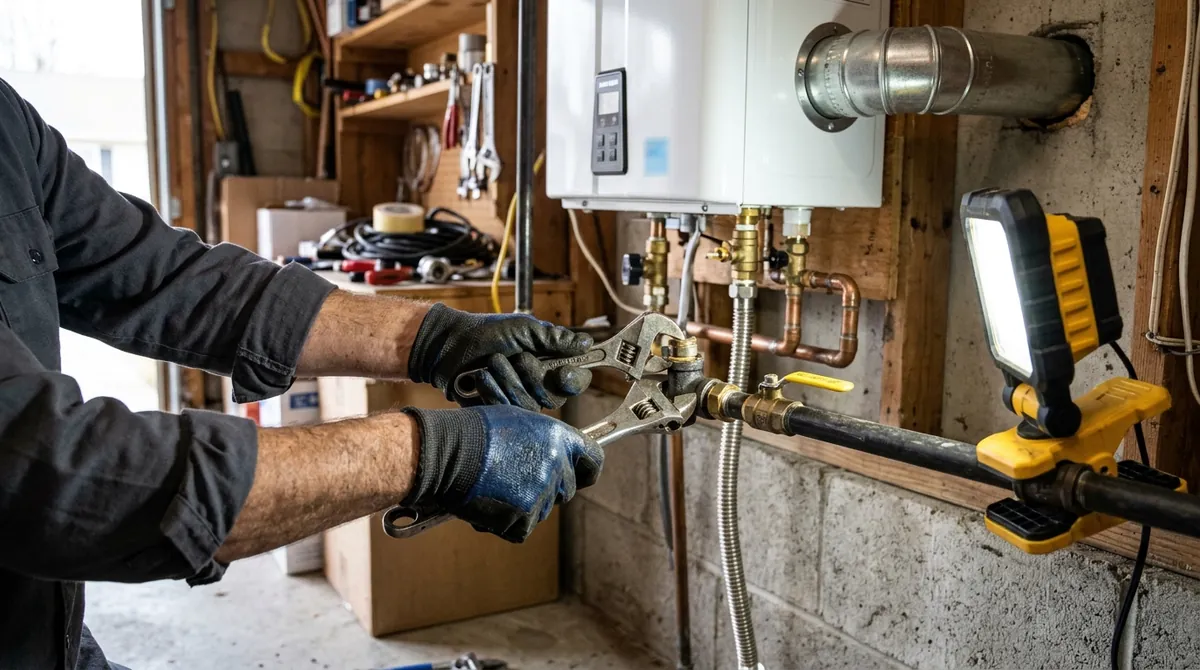
A tankless water heater, also called an on-demand unit, has no storage. When you open a hot tap, water flows through a heat exchanger and a gas burner or electric element heats it on the spot. When you close the tap, it shuts off.
The U.S. Department of Energy's building science center describes gas tankless units as providing hot water on demand "without the standby losses associated with tank storage water heaters". Standby loss is the heat a tank gives off to the room around it, all day and night, whether anyone is using hot water or not.
Tankless vs Tank at a Glance
| Tank | Tankless | |
|---|---|---|
| Upfront cost | Lower | Higher, more so if venting or gas supply needs work |
| Hot water supply | Runs out once the tank is used up | Doesn't run out, but is limited by flow at one time |
| Energy use | Keeps a full tank hot around the clock | Heats only when a tap is open |
| Space | Floor space for the tank | Mounts on a wall |
| Install time (our typical) | A same-type tank swap is usually the quickest job | 3 to 5 hours tankless to tankless; 1 to 2 days tank to tankless |
| Upkeep | Flush the tank to clear sediment | Descale the heat exchanger, more often on hard or well water |
Upfront Cost: What Drives the Price
A tank-to-tank swap is usually the lower-cost job, because the gas line, venting and water connections are already sized for a tank. A tank-to-tankless upgrade often costs more for three reasons.
- Bigger fuel demand. A gas tankless unit burns much more gas while it runs than a tank burner does. Some homes need a larger gas line from the meter.
- New venting. Many gas tankless units vent differently from the old tank, so a new vent through a wall or roof may be needed.
- Electric capacity. Electric tankless units draw a lot of power at once. Some panels need added capacity to carry one.
We check your gas or electric supply, venting path and water lines before we price anything. You get one flat-rate price, parts and labor included, before work begins. If the numbers don't work for your home, we'll price a tank too so you can compare. Financing through Wisetack is available, subject to approval.
Hot Water Supply: Running Out vs Flow Limits
The most common complaint about tanks is running out. Three showers in a row in a busy household can empty a 40-gallon tank, and the last person gets a cold one.
A tankless unit never runs out, but it has a different limit: how much water it can heat at the same moment. The Department of Energy's building science center notes that high-efficiency tankless units typically deliver 2 to 5 gallons per minute. A shower and a dishwasher running together may be fine. Two showers and the washer at once may be more than a small unit can keep hot.
That is why sizing matters. We size a tankless unit to how many hot taps your household runs at once, not to the number of bathrooms on the floor plan.
A rule of thumb from what we see in South Sound homes:
- Tank tends to suit households that use hot water in short bursts, homes where the current tank setup works well, and owners who plan to sell in the next few years.
- Tankless tends to suit larger families who run out of hot water, homes short on space, and owners who plan to stay long enough for the lower running cost to add up.
Running Cost and Lifespan
A tank heats and reheats the same water all day to keep it ready. A tankless unit only fires when a tap is open. For most households that means lower energy use with tankless, though how much depends on how much hot water you use and whether the unit is gas or electric.
The same Department of Energy page lists a longer life expectancy among the benefits of tankless units. A tank's life is limited by the steel tank itself: once the inside rusts through, it leaks and has to be replaced. A tankless unit has no tank to rust, and its parts can be serviced.
We won't promise a payback date, because it depends on your usage and your utility rates. Ask us to walk through the numbers for your house.
Upkeep: Flushing vs Descaling
Both types need some care.
- Tanks collect sediment at the bottom. A yearly flush helps the tank heat efficiently and can stretch its life.
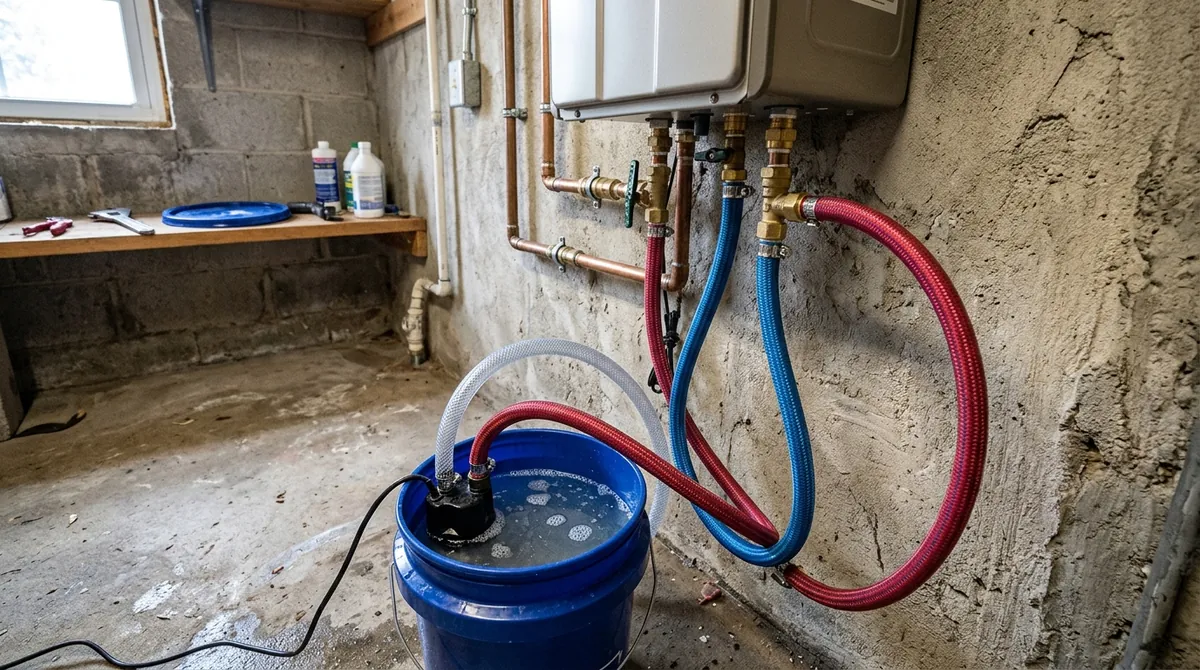
- Tankless units collect mineral scale inside the heat exchanger. Scale narrows the water path, which shows up as weak hot water flow or a scale error code on the display. A descale and flush usually takes us 1 to 2 hours.
When we install a tankless unit, we add service valves so it can be descaled without cutting into the pipes later.
Tacoma and South Sound Homes: What Changes the Answer
Where you live in the South Sound affects which one fits.
Garages with wall space. Many newer homes in Bonney Lake, Maple Valley and South Hill have garages or utility rooms with plenty of wall space and a straight path outside for venting. Those are often the simpler tank-to-tankless jobs.
Older Tacoma homes. In many older houses in the North End and around Proctor, the water heater sits in a basement or a tight closet with an old flue. A tankless upgrade there may need a new vent route, which adds to the price. A new tank in the same spot is often the simpler fix.
Wells and minerals. Around Gig Harbor and in rural Thurston County near Olympia, many homes are on private wells. Well water can carry iron, manganese or hardness, and those minerals build up inside a tankless unit faster. If you're on a well, plan on descaling more often. Ask about our free water quality test, which shows what is in your water and whether filtration would help either type of heater.
Wet, cold winters. Incoming water is colder in winter, so any heater works harder from November to March. A tankless unit that is undersized for winter may struggle to keep two showers hot at once. That is one more reason to size it to your household, not to the brochure.
Questions to Ask Before You Choose
Bring these to any plumber you call, including us.
- How many hot taps do we run at the same time? This sets the tankless size, or the tank size.
- Does my gas line and venting work for a tankless unit as it is? If not, what has to change, and is that in the price?
- Is the quote flat-rate, with parts and labor included? Ask what could change it.
- What upkeep will this unit need on my water? Wells and harder water mean more frequent descaling.
- What warranty comes with the unit and the labor? Our work is backed by our labor warranty, plus the manufacturer's warranty on the equipment.
- Can I see both prices? A fair company will price a tank and a tankless option when both could work.
If your current tank is failing and you're deciding whether to repair it or replace it at all, our guide to water heater repair or replacement covers that call first.
Get Both Prices From Rooter-Man
If you're weighing a tankless upgrade, call Rooter-Man Plumbing of Tacoma at (253) 600-1335 or send us a message. A real person answers 24/7. We'll check your gas or power supply, venting and water lines, then give you a flat-rate price for the option that fits, and a tank price too if you want to compare. Learn more about our tankless water heater installation and repair for Tacoma and the South Sound, or see our water heater replacement service if you'd rather stay with a tank.